


By now, we’re sure you’re familiar with what VO2 max is, why it matters, and what a good score looks like. The next step is to work out your individual VO2 max score.
There are several ways to determine your VO2 max, but they do not all provide the same level of accuracy.
Smartwatches, running tests and online formulas can all be used for calculating VO2 max, and they do this by estimating your result from factors such as heart rate, speed or exercise performance. If you want to measure VO2 max directly, though, laboratory testing using respiratory gas analysis is the recognised, gold standard approach.
At Marylebone Health, VO2 max is measured as part of our Cardiopulmonary Exercise Testing (CPET or CPEX) service. Rather than only focusing on the number itself, this in-depth testing allows our physiology team to examine your response to progressively more demanding exercise and provide data that can be applied to your individual health, fitness or performance goals.
Measuring VO2 Max vs Calculating VO2 Max
Firstly, when looking at how to measure VO2 max, it’s important to understand the difference between a measured and estimated score.
Direct measurement requires specialist equipment that is capable of analysing the gases you breathe during exercise. As the exercise intensity increases, this equipment determines how much oxygen your body is consuming, then uses this data to establish your maximum oxygen uptake.
Fitness watches, field tests and formulas use other measurable information – such as heart rate, running performance, distance or workload – to simply predict what your VO2 max is likely to be.
Both approaches have their uses. An estimate can provide a convenient indication of aerobic fitness and help you follow general trends, but direct laboratory testing is more appropriate when accuracy matters or when you want more detailed information about your physiological response to exercise.
Calculating VO2 Max: How Is the Number Worked Out?
When VO2 max is measured directly, the calculation is based on respiratory gas exchange during exercise.
In basic terms, the result is derived from the millilitres of oxygen consumed per kilogram of body weight per minute (ml/kg/min).
Can You Calculate VO2 Max Yourself?
Yes, and in fact, there are several field tests that can be used for calculating VO2 max without specialist laboratory equipment.
Common examples include the Cooper 12-minute run, in which the distance covered in 12 minutes is used to estimate aerobic capacity, and multi-stage shuttle or “bleep” tests, where performance is converted into an estimated VO2 max. Other methods use running times, walking tests, cycling performance or heart-rate response.
These methods are accessible, which is their main advantage. You might only need a measured distance, stopwatch and heart rate monitor to get an estimated VO2 max, depending on the protocol – and this is likely to be enough for you if you just want a broad indication of your aerobic fitness.
The limitation is that you are calculating an expected VO2 max based on your performance rather than directly measuring your oxygen consumption. Plus, your result may be affected by factors that aren’t directly related to your true aerobic capacity. There are lots of things that could impact your performance on the day, including pacing, motivation, running efficiency, familiarity with the test, environmental conditions, and how accurately you follow instructions.
What Happens During a VO2 Max Test?
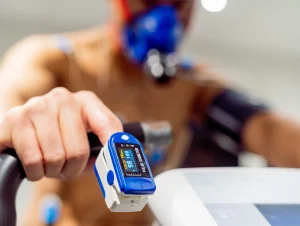
Laboratory VO2 max testing involves a graded exercise test on a treadmill or stationary bike in our specialist CPEX laboratory. You wear a specialist mask connected to metabolic testing equipment while the exercise intensity progressively increases.
The equipment analyses your respiratory gases throughout the assessment – closely monitoring how much oxygen is entering your body and how much carbon dioxide you are producing – and enabling your oxygen consumption to be measured directly.
The workload gradually increases, making exercise progressively harder. And as the intensity rises, oxygen consumption increases until your maximum aerobic capacity is established.
Unlike an outdoor fitness test, this takes place under controlled conditions where multiple physiological responses can be observed simultaneously.
Why We Look Beyond the VO2 Max Number
At Marylebone Health, we rarely measure and view VO2 max in isolation. Knowing your maximum aerobic capacity is valuable but understanding how you reach that maximum can provide equally useful insights into your current and long-term health.
During CPET, we also assess markers such as your ventilatory/lactate threshold, respiratory compensation point, aerobic power output and heart-rate response. Together, these help build a more detailed picture of how your body performs as exercise intensity changes.
This matters when turning test results into something practical. Two people could record similar VO2 max scores yet have different physiological thresholds and require completely different approaches to training.
Whether your priority is improving endurance, preparing for an event, returning to fitness or maintaining physical capacity for as long as you can, our physiology team can use this individual data to help establish appropriate cardiovascular exercise intensities.
The Industry Leading Expertise Within Marylebone Health
Our approach to measuring and interpreting VO2 max data is informed by the experience of Jim Pate MSc BSc (Hons), our Senior Physiologist and Lab Manager, who leads the group’s exercise physiology services and specialises in cardiopulmonary exercise testing. Jim’s background spans both clinical and performance physiology; he has worked within the NHS, lectures and conducts research internationally, and is involved in multiple projects looking at the clinical applications of exercise physiology, including working alongside the St Thomas’ Hospital cancer group. Jim was also part of the Extreme Everest Expedition at Everest Base Camp, investigating how extreme conditions affect human performance, survival and longevity.
Discover how our clinical expertise can provide you with accurate insights into your fitness and support your broader health journey. For bookings, prices and more information on our CPET capabilities, please contact us on 0207 637 7677 or email info@marylebonehealthgroup.com